
Choosing your first VFX software can feel like a major decision. Beginners often see Houdini and Maya mentioned in tutorials, job posts, studio breakdowns, and school program pages, but it’s not always clear how these tools differ.
Both programs are used by professional artists in film and animation pipelines, and both are worth learning if you want to build a serious VFX career. Generally speaking, Maya is often the stronger entry point for learning the structure of 3D scenes, whereas Houdini is especially known for procedural effects and simulations.
Understanding the differences can help aspiring VFX artists choose the right starting point for their goals, so let’s dig a little deeper!
Why the Houdini vs Maya Question Matters
When students compare Houdini and Maya, they’re really comparing different ways of working.
Maya is widely used for modeling, rigging, animation, layout, and general 3D production. It gives artists a direct way to create objects, move characters, set cameras, build scenes, and understand how 3D work fits together. For beginners, that makes Maya easier to approach because many tasks feel visual and hands-on.
Houdini is built around procedural workflows for simulation-heavy work, where artists can create systems that generate or control effects. Instead of only changing one object by hand, a Houdini artist can build a setup that controls smoke, fire, water, destruction, particles, or large-scale environmental effects.
As you can see, each tool is important, but they support different ways of working. So which one students learn first will shape how they understand the entire VFX process.
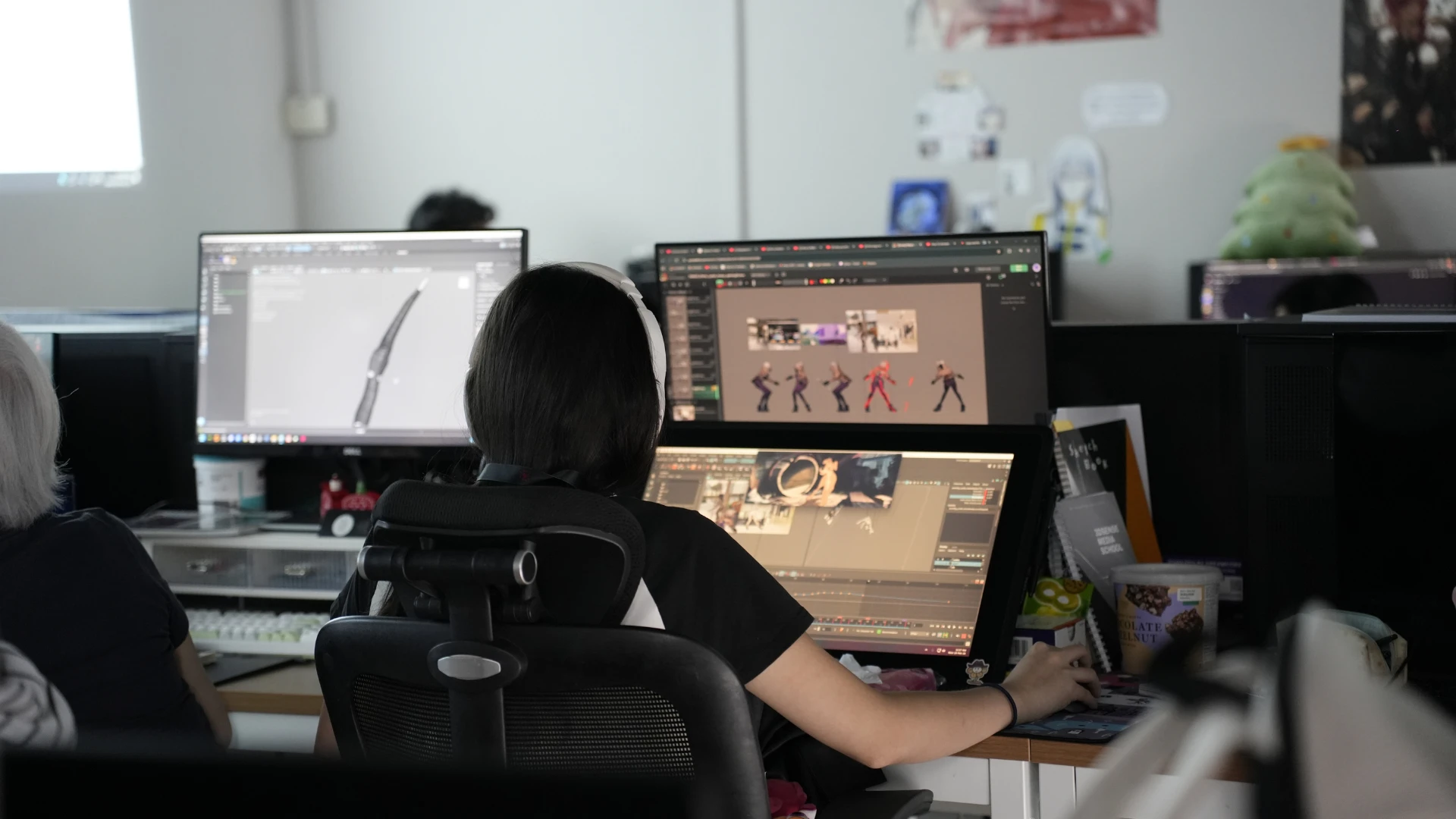
A 3dsense Media School student working on Autodesk Maya during class.
What Maya Does Best
Maya introduces core production skills behind many 3D and VFX shots. Students can model simple objects, animate movement, set cameras, adjust lighting, and see how those choices affect the final image. They can also begin to understand how characters are rigged, how scenes are staged, and how assets move through a production workflow.
These foundational competencies are crucial because VFX isn’t just about explosions, smoke, fire, or destruction. Before artists can add advanced effects convincingly, they need to understand how a shot is built: how objects occupy space, how movement reads on camera, how lighting affects realism, and how scale shapes the audience’s sense of the scene.
That’s why Maya is often a smart choice to study first. Maya gives students a practical way to learn modeling, animation, rigging, layout, lighting, and rendering before they move into more specialized effects work. This also aligns with advice from VFX Cookbook, which frames Maya as a strong choice for artists focused on animation, character work, and general 3D production.
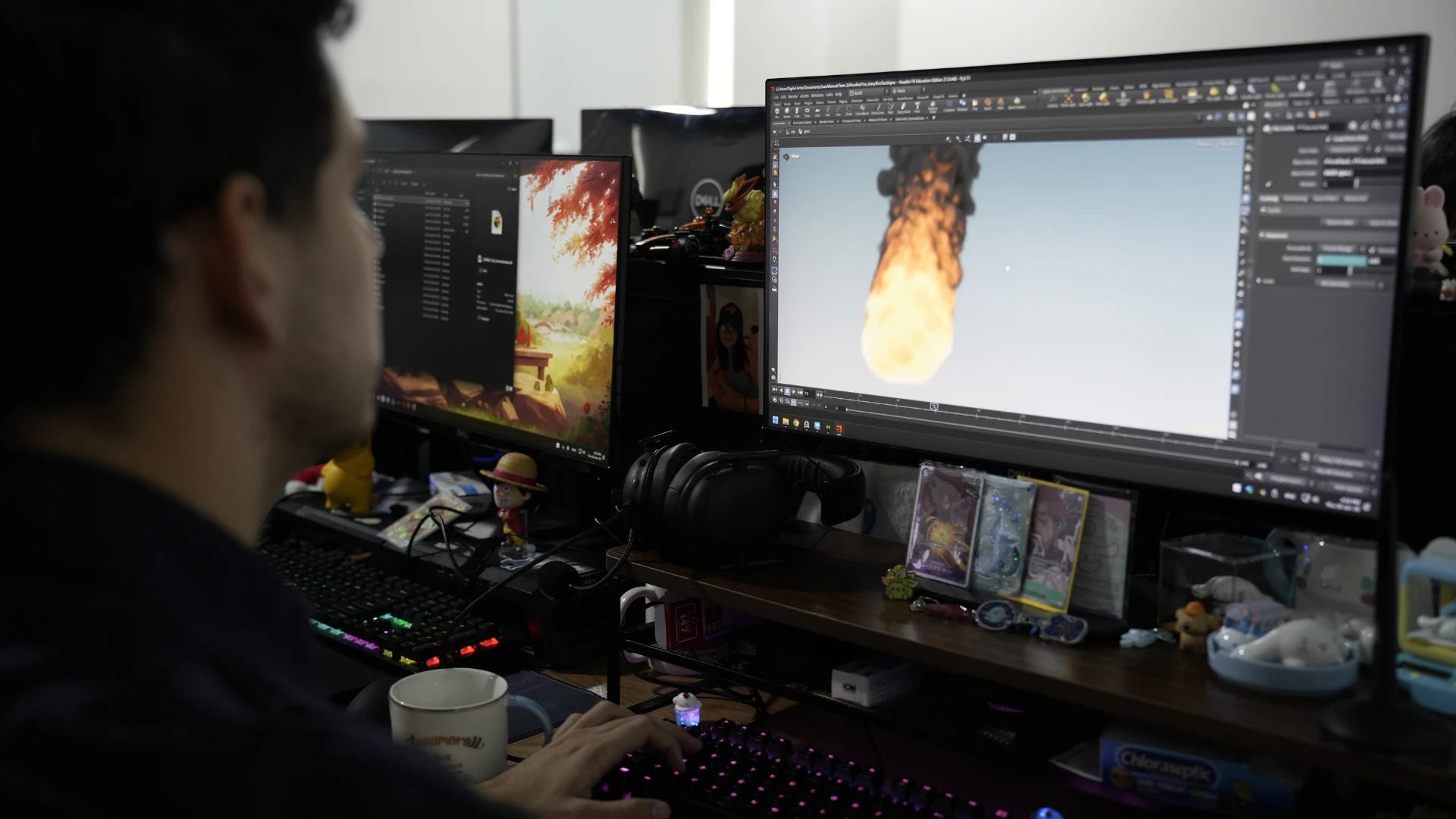
A student builds a procedural effects setup in SideFX Houdini.
What Houdini Does Best
Houdini is one of the best software tools for VFX artists because it gives them deep control over complex visual effects. It’s especially powerful for simulations and procedural work, with effects like smoke, fire, water, dust, cloth, particles, crowds, and destruction that make scenes feel cinematic and believable.
In Houdini, artists don’t only create or edit objects manually; they use nodes to build systems. Those systems can be adjusted, repeated, and reused. If a shot needs more smoke, slower debris, or a bigger explosion, the artist can change the system instead of starting from scratch. That’s an invaluable benefit in professional VFX workflows!
Artivoxa’s detailed comparison also describes Houdini as especially strong for VFX and simulation, while Toxigon highlights its procedural power. But for beginners, Houdini can feel more technical and demanding.
The node-based workflow requires artists to think in terms of systems, rules, parameters, and cause-and-effect relationships. That makes for a steep learning curve at first, but those up to the challenge will learn how to control complex effects in a flexible, production-ready way.
Maya vs Houdini for Film
When comparing Maya vs Houdini for film, the truth is these programs have different uses for different parts of the pipeline. A film shot might use Maya for character animation, layout, or camera work, then switch to Houdini for smoke, destruction, and environmental effects. After that, the shot may move into lighting, rendering, and compositing.
So it’s not about which one is better, but simply which one you want to learn first. As stated above, Maya is the more practical first step because it teaches the foundation of 3D production. Once that foundation is in place, Houdini becomes much easier to understand.
However, students who know they want to specialize in simulations or procedural effects might want to jump into Houdini earlier. Learning Maya remains useful either way, because VFX artists still need to understand how their effects fit into a full production pipeline.
Which Tool Should You Learn First?
For most aspiring VFX artists, we suggest studying Maya first, then Houdini. Maya gives you the foundation. Houdini gives you the specialization. So the best starting point is learning the basics, such as:
- 3D navigation
- Modeling simple objects
- Scene layout
- Animation basics
- Cameras and lighting
- Rendering simple scenes
- Basic VFX workflow
Next, students can move into Houdini by practicing:
- Simple simulations
- Particles
- Smoke and fire
- Water effects
- Destruction effects
- Portfolio-ready VFX shots
The learning path helps students avoid the mistake of tackling advanced effects before understanding the basics of 3D production. So, should you learn Maya or Houdini? Ideally, both, but in the right order.
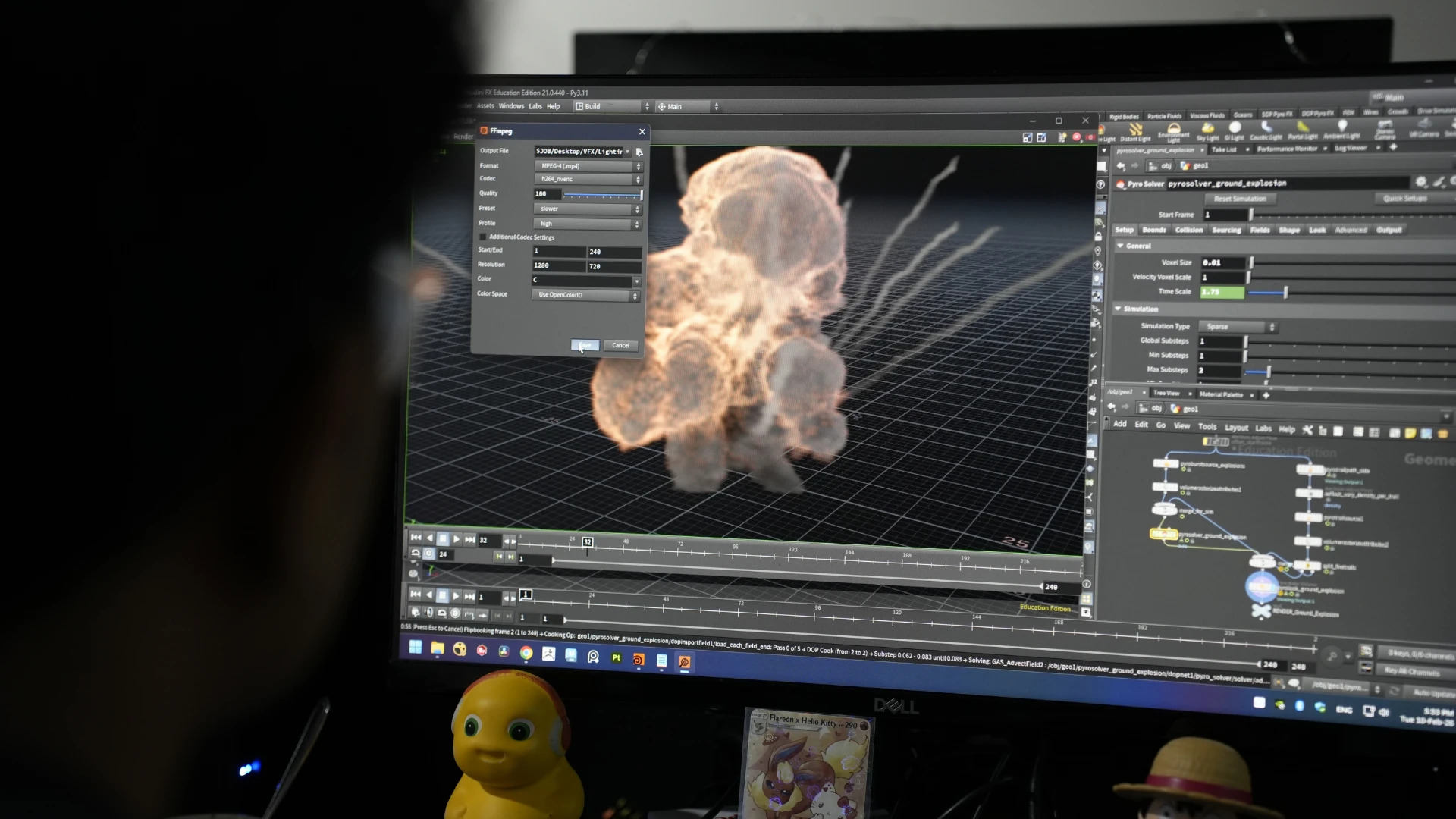
Students develop industry-ready Houdini skills in the Diploma in 3D Animation, VFX & 3D Modeling.
Building Industry-Ready VFX Skills
The best VFX artists aren’t just software users; they’re visual problem-solvers who understand movement, timing, realism, design, lighting, storytelling, and production expectations. Maya and Houdini both help build those skills, but they do so in different ways.
That’s why learning both tools in a structured program can be so valuable. 3dsense Media School’s Diploma in 3D Animation, VFX & 3D Modeling is an immersive 12-month program designed for aspiring animators and VFX artists who want to build real skills in 3D animation, visual effects, and 3D modeling.
Through hands-on training in Maya, Houdini, and ZBrush, students learn from expert instructors with real industry experience. The program helps students build the skills needed to animate lifelike creatures, design visually compelling scenes, and create polished, portfolio-ready projects.
If you’re ready to build the skills, workflow, and portfolio needed for modern VFX production, check out the 3dsense Diploma in 3D Animation, VFX & 3D Modeling program today.





 Chat Now